
A nominal 60 mm designation tells you only part of a casement system: it usually identifies the frame-system depth, not the glazing capacity, reinforcement, hardware compatibility or tested performance. By checking section drawings, the complete profile family, fabrication limits and supplier documents, you can approve a profile schedule that fits your window design before ordering material or dies.
Key takeaways
- Confirm that “60” refers to outer-frame depth, not a performance rating.
- Request the complete profile, glazing, gasket and reinforcement catalogue.
- Verify sash weight, glass thickness, hardware compatibility and steel limits.
- Calculate frame, sash, mullion, bead and gasket quantities before ordering.
What does “60” mean in a casement uPVC profile system?
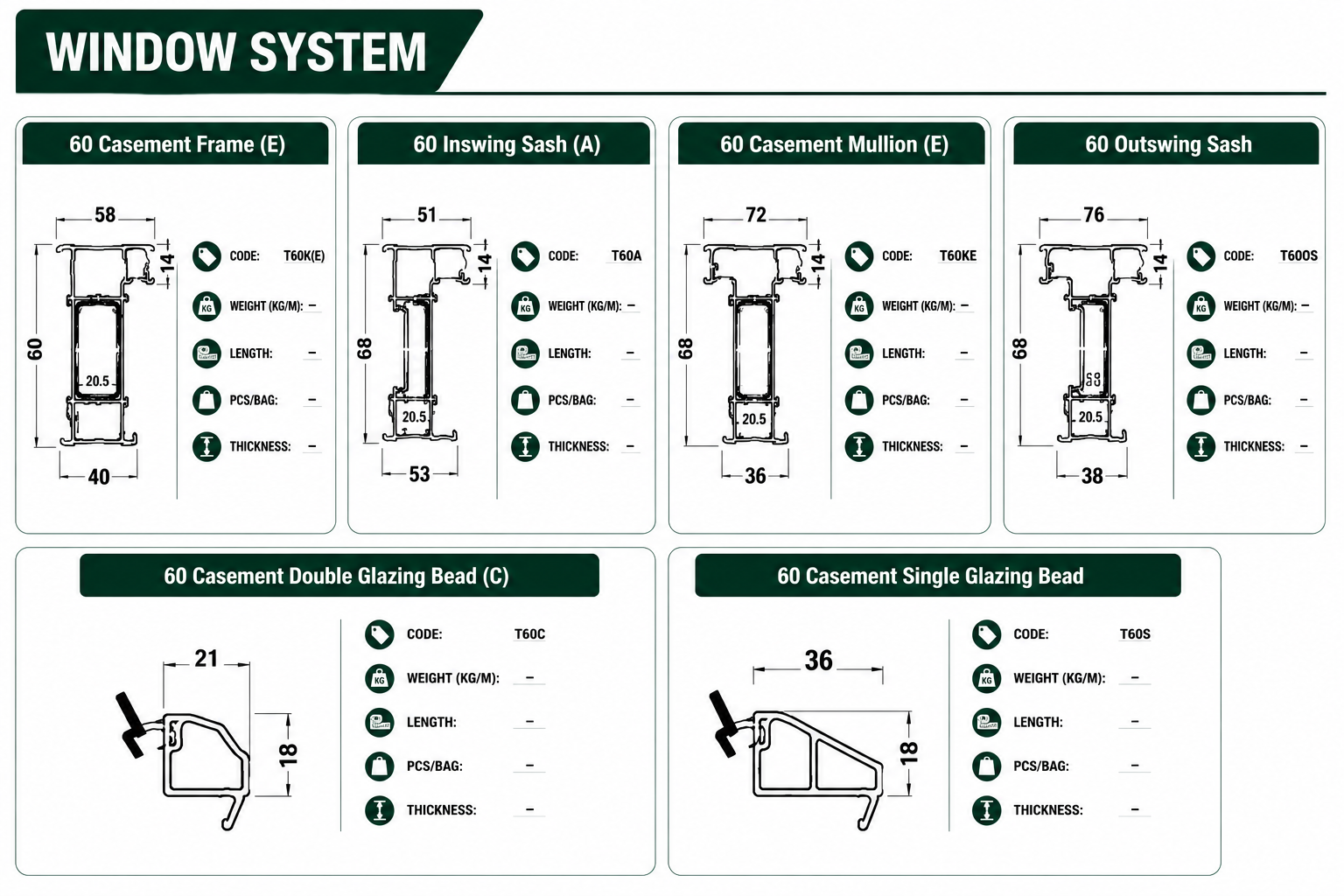
“60” normally means a nominal outer-frame system depth of about 60 mm. It is not a universal performance class and does not guarantee a 60 mm sash depth. A search for a 60 casement series in Bengaluru is only a starting point, not a technical specification.
Verify the number on the supplier’s current section drawing:
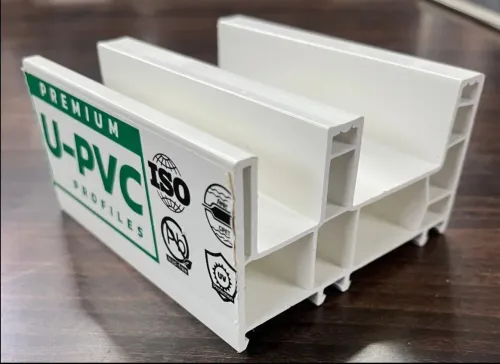
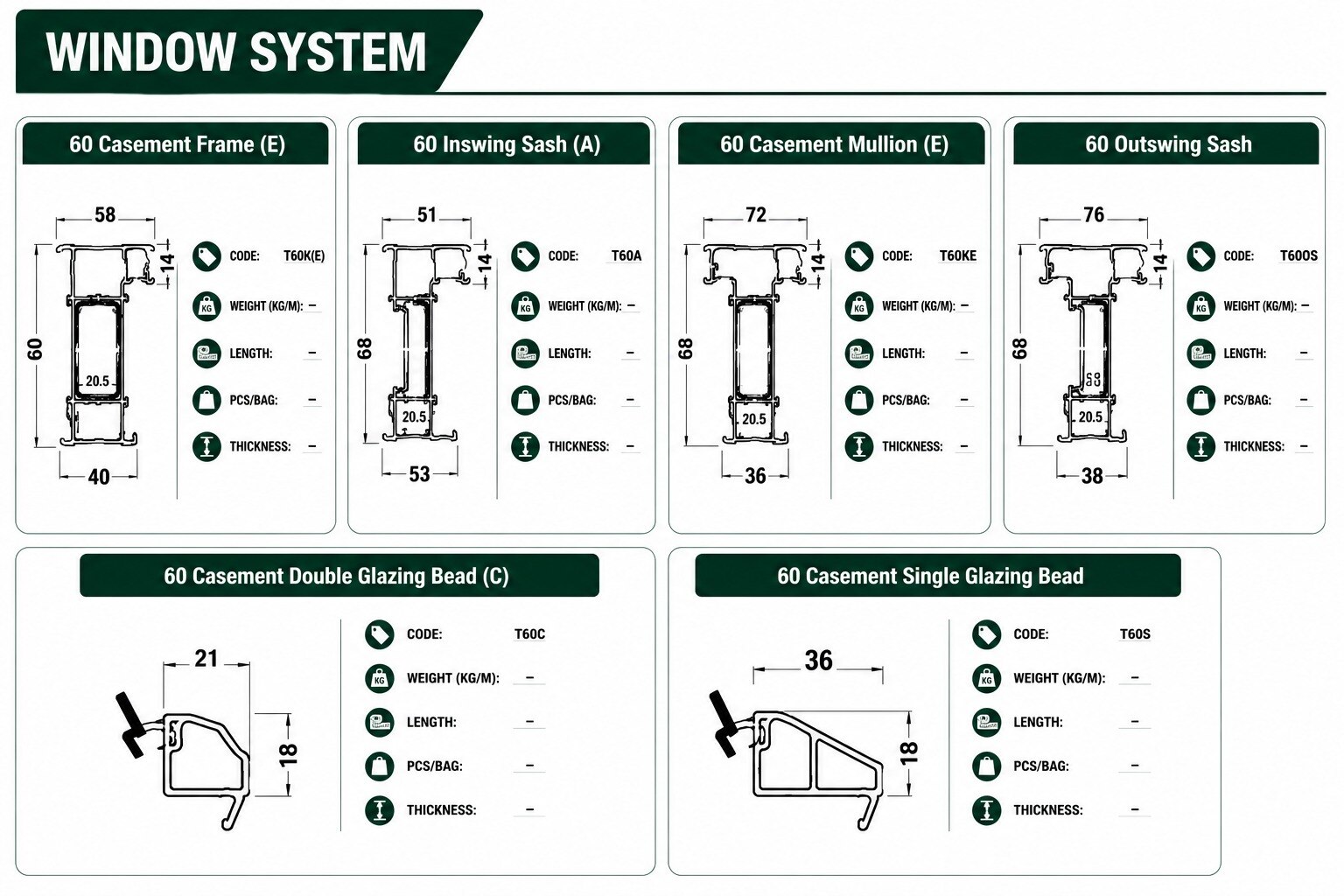
1. Measure the external frame depth across the finished section, then identify the sash depth separately. Record the chamber count, wall thickness, glazing rebate, sash overlap, mullion and transom dimensions, gasket grooves, reinforcement chambers and coupling interfaces. Do not measure a catalogue photograph.
2. Obtain the tested limits for the exact assembly. The series name cannot establish air leakage, watertightness, wind resistance, acoustic performance or permitted glass thickness. Those results depend on the fabricated window, its glass, hardware, reinforcement, sash size and opening direction.
3. Match every component to one system: outer frame, sash, mullion, transom, bead, gasket, reinforcement and drainage parts. Mixing profiles with a similar nominal depth can produce poor gasket compression, an incorrectly seated bead or failed hardware engagement. It can also misalign drainage paths.
Check that the drawing shows tolerances, not only nominal dimensions. The frame and sash must also provide compatible reinforcement and coupling interfaces; a 60 mm label cannot confirm those details. Ask for the revision date before fabrication, because an older section drawing can show obsolete beads, gaskets or hardware clearances.
Which profiles, glass and sealing parts belong in the 60 Casement catalogue?
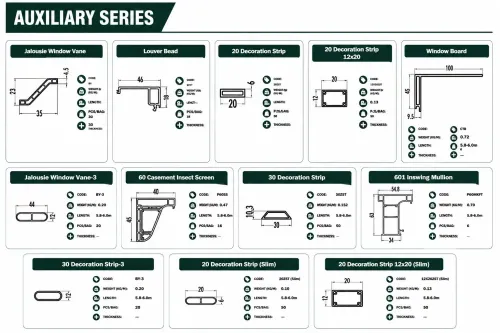
Request a complete matched section family, not just a 60 mm frame extrusion. A casement uPVC profile supplier in Bengaluru should provide:
- Outer frames
- Opening sashes
- Meeting stiles
- Dummy sashes
- Mullions and transoms
- Glazing beads
- Interlocks
- Couplers
- Bay-window connectors
- End caps
- Reinforcement-compatible sections
- Fly-screen frames, adapters and mesh-retaining details
Ask for the exact glazing range for every frame-and-sash combination. Record bead geometry, rebate depth, gasket type, gasket reference and permitted glass build-up; never infer pane thickness from “60 mm”.
| Glass option | What to confirm | Why it matters |
|---|---|---|
| Single glass | Permitted pane thickness and bead/gasket combination | A narrow rebate can reject thicker panes |
| Double insulating glass unit | Overall IGU thickness, spacer clearance and sealing details | The unit may not fit even when the frame is 60 mm deep |
| Laminated insulating glass unit | Total laminated build-up, weight limit and approved bead | Extra glass weight affects sash operation and hardware loading |
For Bengaluru monsoons, inspect unobstructed frame and sash drainage channels, correctly positioned external weep outlets and drained glazing rebates. Ask how unused chambers are sealed or capped. Installation sealant must stay clear of channels, outlets and rebate drains; blocking them traps water inside the frame and can cause leakage despite a sound profile system.
Include drainage accessories and fly-screen provisions in the catalogue and quotation.
What reinforcement, sash and hardware limits must you verify?
A 60 mm profile depth cannot select reinforcement. Ask for the exact steel grade or material, recommended thickness in millimetres, chamber position, fixing pitch, maximum unsupported length, sash width and height limits, maximum glass weight, and maximum hardware load.
- Side-hung: verify hinge-side reinforcement, friction-stay capacity, sash overlap, espagnolette alignment, handle height, lock keeps, corner drives and drainage clearance. Confirm the permitted sash dimensions for the proposed glass weight and opening direction.
- Top-hung: verify stay capacity, hinge or pivot reinforcement, restrictor compatibility, handle and espagnolette position, lock-keep engagement, sash overlap and unobstructed drainage. Ask for the maximum width, height and hardware load separately from side-hung limits.
- Fixed light: verify frame reinforcement, maximum unsupported width and height, glass weight, wind-pressure limit, glazing rebate and drainage arrangement. Do not apply opening-sash limits to a fixed panel.
Request an interface schedule covering espagnolette locks, friction stays, handles, hinges, restrictors, corner drives, shoot bolts and lock keeps. Check hole positions, handle height, hinge-side steel, sash overlap, keep geometry and drainage clearance against the exact section drawing.
Glass weight, wind pressure, opening direction, profile colour, sash dimensions and hardware loads all affect the choice. Rigid PVC-U expands about 0.07 mm/m·K: a 2 m member across 30 K changes by about 4.2 mm. Obtain expansion allowances, fixing pitch and slotted-hole guidance before searching for upvc casement profiles near me.
How should you calculate quantities and check fabrication before ordering?
Start with the project engineer’s opening schedule, not a supplier’s estimated profile quantity. For each opening, match the configuration to the exact fabrication manual before converting dimensions into cuts.
1. Record the opening reference, finished width, finished height, fixed or opening configuration, opening direction, sash clearances, and glass specification.
2. Calculate frame, sash, mullion and transom cut lengths from the manual’s fabrication tables. Add couplers, beads, gaskets, reinforcement lengths, drainage components, end caps and other accessories to the take-off.
3. Use only the exact system manual for welding deductions, corner allowances, bead measurements, sash clearances and reinforcement cut-backs. “60 Casement” is not a cutting formula; guessing these values can produce loose gaskets, wrong glass retention or a frame that will not fit the opening.
4. Check fabrication controls before production: square end preparation, specified welding temperature and time, correct welding pressure, thorough corner cleaning and limited removal of the weld bead. Excessive bead removal weakens the joint and can create a leakage path.
5. Require current section drawings with dimensions and tolerances, fabrication tables, reinforcement schedules, gasket and bead references, and drainage details. Request test reports identifying the tested window size, glass, hardware, reinforcement and opening direction.
For anyone choosing a 60 casement for profile supplier in bengaluru, compare the supplier’s documents against your schedule. Do not release material until every cut length, reinforcement cut-back, bead reference and drainage route is traceable to the same matched system.
How do you compare a 60 Casement supplier in Bengaluru?
Start by proving what the supplier is, not where the search result appears. A profile manufacturer or authorised system distributor owns or represents the system; a fabricator makes windows from bought-in sections, while a reseller may only hold stock. Search for a casement window profile manufacturer in Bengaluru, then request:
- Current section drawings with dimensions and tolerances
- Extrusion batch identification and traceability records
- System ownership or written distributor authorisation
- Glazing, reinforcement, gasket and bead limits
- Welding temperatures, times, pressures and cleaning guidance
- Hardware compatibility notes for locks, stays, hinges and handles
- Drainage layouts and colour-specific expansion instructions
| Supplier type | Evidence to expect | Warning sign |
|---|---|---|
| Profile manufacturer | Complete 60 mm section family, technical manual and batch records | Only one frame extrusion is available |
| Authorised distributor | Manufacturer authorisation, current documents and traceable stock | Authorisation cannot be verified |
| Fabricator | Finished-window samples and fabrication capability | Cannot provide system drawings |
| Reseller | Price and stock availability | No ownership, test data or technical support |
Treat test reports as evidence for the fabricated and glazed assembly, not the extrusion alone. A report for another sash size, glass unit or reinforcement layout does not prove your proposed window.
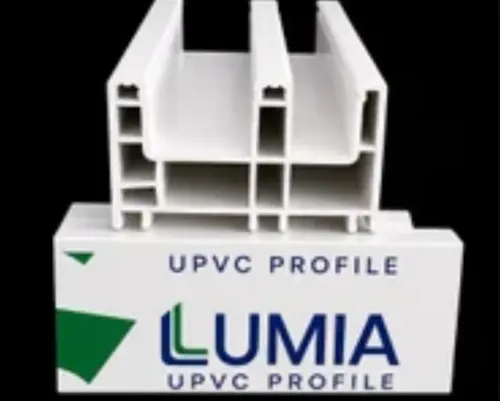
Normalise every quotation against identical opening sizes, opening types, glass build-up, reinforcement, hardware grade, fly-screen provision, couplers, installation method and taxes. Evaluate LUMIA UPVC PROFILE on whether it supplies that complete family and documentation. Proximity reduces freight time; it does not prove compatibility or traceability.
Related product
 | Casement Series The 60 Casement Series by Lumia uPVC Profile is designed to deliver exceptional durability, energy efficiency, and modern aesthetics for contemporary... View product → |
Frequently asked questions
What does “60” mean in a casement uPVC profile system?
“60” normally identifies a nominal outer-frame system depth of about 60 mm. It does not guarantee a 60 mm sash depth or define the window’s performance.
Which profiles, glass and sealing parts belong in a 60 Casement catalogue?
Ask for the complete catalogue covering outer frames, sashes, mullions, transoms, glazing beads, adapters, drainage parts, glazing options and compatible gaskets.
What reinforcement, sash and hardware limits must you verify?
Check the approved steel reinforcement size, sash dimensions, sash weight, glass thickness, hinge capacity, locking-point limits and hardware compatibility before fabrication.
How should you calculate quantities and check fabrication before ordering?
Prepare a schedule of frame, sash, mullion, transom, bead, gasket, reinforcement and hardware lengths, then confirm cut lists, weld allowances, drainage and glazing clearances.
How do you compare a 60 Casement supplier in Bengaluru?
Compare catalogue completeness, technical drawings, reinforcement guidance, sample support, batch traceability, delivery reliability and fabrication assistance rather than comparing the “60” label alone.