
A colored or wood-look uPVC frame can change a Bengaluru building’s character without the recurring sanding and repainting associated with timber, but appearance alone does not prove outdoor durability. By the end, you will know how to assess the film construction, specify compatible components, account for Bengaluru’s heat and monsoon conditions, and protect the finish from fabrication through installation.
Key takeaways
- Choose factory-bonded exterior film, not post-installation paint.
- Inspect film coverage, corners, welds and sample consistency before approval.
- Specify UV, moisture and cleaning requirements for Bengaluru installations.
- Use mild detergent and repair matching film damage promptly.
What film colors change—and what they do not
A wood-tone or solid-color film changes the frame’s visual identity, not its core material. It is a factory-applied exterior-grade decorative layer bonded to uPVC, rather than paint applied after installation or an interior laminate exposed to weather.
You gain a timber-like appearance without routine staining, sanding and repainting, but the profile still needs cleaning and clear drainage paths.
| Finish | Practical benefit | What it does not change |
|---|---|---|
| White uPVC | Low-maintenance, neutral appearance and easy coordination | It offers no timber or metal visual effect |
| Film-colored uPVC | Wood grain, dark tones and stronger architectural contrast without painting the installed frame | It does not make uPVC structurally equivalent to timber or automatically improve insulation |
| Timber | Natural material and authentic grain depth | It demands protective coatings, sanding and repainting as the finish weathers |
| Metal finish | Slim-looking, contemporary appearance and many coating colors | Coating scratches, dents and thermal movement still require attention |
The practical benefits of lumia film colors in bengaluru depend on the film, not its color name. Ask for evidence covering UV and weathering resistance, adhesion, color change, gloss change and compatibility with the uPVC substrate.
A colored frame does not automatically have a lower U-value than white uPVC; glazing, spacer, frame Uf, sash design and installation determine whole-window performance. Deep scratches and abrasive cleaners remain visible, so handling and maintenance still matter.
How to judge a film’s coverage and visual quality
A flat sample can hide the defects that appear after fabrication. For decorative uPVC window profiles, inspect the film on every visible face, not only the front: check whether it covers the sash, frame, glazing bead and outer return, and whether the edge remains protected after cutting.
Ask the supplier whether the finish is applied to one face or multiple faces, and how it bonds to the uPVC. Request the lamination or adhesion specification, film batch number, and acceptance limits for peeling, blistering and edge lifting. A generic “UV-resistant” claim does not prove that the bond will survive heat, rain and cleaning.
Check each sample against the finished corner you will actually produce.
| Check | What to inspect | Failure revealed |
|---|---|---|
| Colour and grain | Daylight view, grain direction and batch match | Patchy colour or reversed wood effect |
| Welded corner | Film continuity after welding and cleaning | Burn marks, lifting or visible weld lines |
| Surface finish | Gloss, scratches, bubbles and dust inclusions | Poor handling or uneven lamination |
| Profile coverage | Frame, sash, bead and exposed returns | White edges or mismatched faces |
For wood tone uPVC profiles in Bengaluru, judge appearance in daylight and on a completed welded corner, not from a loose strip. Confirm that matching profiles, beads and accessories use the same colour code and batch controls; otherwise one window can show several shades.
A limited approved palette is easier to keep consistent than many low-volume colours.
What Bengaluru weather demands from a colored frame
Dark films absorb more solar energy than white profiles, so thermal movement deserves attention in Bengaluru’s sun. Ask the system supplier for span tables, maximum sash dimensions and reinforcement requirements for the selected color; do not choose reinforcement only from window size or hardware load.
A larger dark sash can bind, distort or stress welded corners if the specification matches a white frame.
A colored frame also does not make the room cooler or automatically lower the window’s U-value. Indoor heat gain depends on glazing solar factor, glass Ug, frame Uf, spacer, orientation and external shading. Coordinate the film color with solar-control glass and shading rather than treating a dark wood effect as insulation.
Request evidence that covers the complete exposed finish:
- Factory-applied exterior-grade film, not interior laminate or site-applied paint
- Adhesion to the uPVC substrate and compatibility with gaskets, sealants and welding
- Accelerated weathering method, exposure cycle, color-change limit and gloss-retention limit
- Separate warranty terms for the film surface and the fabricated window
Monsoon rain and humidity test the drainage system more than the color. Approve sill fall, end dams, gaskets and clear weep paths at system level; a blocked outlet lets water sit against the laminated edge.
Dust and pollution need cleaning access and a finish that tolerates routine washing, while sharp particles or abrasive cleaners can scratch the film. Temperature cycling makes weak perimeter seals open and admit water.
How fabricators should specify and approve colored profiles
Approve the finish before you approve the order. For colored uPVC profiles for fabricators, a color name alone is not a specification: the same “oak” or “grey” label can produce visibly different frames after additions, repairs or a later batch.
1. Record the exact film color code, gloss level, acceptable color variation and every surface to be laminated, including the interior, exterior, sash and glazing beads. Keep an approved sample or signed color panel for comparison.
2. Confirm the approved profile combinations. A frame, sash, mullion, bead, cover and threshold must use compatible film, welding and dimensional systems rather than matching by appearance alone.
3. Get the welding settings for that specific laminated profile and color. Do not copy white-profile temperatures or pressure; inspect welded corners for film lifting, blistering, scorching and heat damage, then remove residue without scratching the visible face.
4. Specify reinforcement by the supplier’s span tables and reinforcement drawings. Dark films increase heat absorption and movement, so do not select steel only from sash size or hardware load.
5. Verify accessory compatibility, including gaskets, glazing beads, handles, drainage components, corner cleaners and sealants. An accessory that stains, abrades or distorts the film can spoil an otherwise sound frame.
6. Request the batch number, storage and orientation instructions, weathering or color-stability test report, warranty terms, repair method and replacement-stock obligation. Store batches separately with protective layers to prevent scuffing.
LUMIA UPVC PROFILE should issue these controls with the quotation, not after fabrication begins. Reject the order if the supplier cannot identify the code, tested combination or correction procedure in writing.
Related product
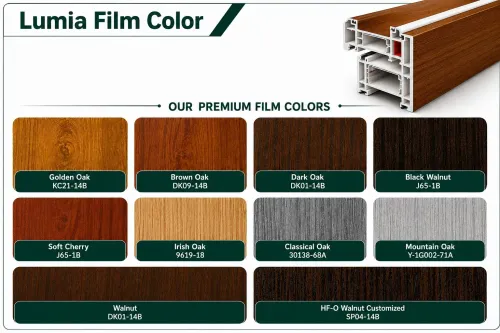
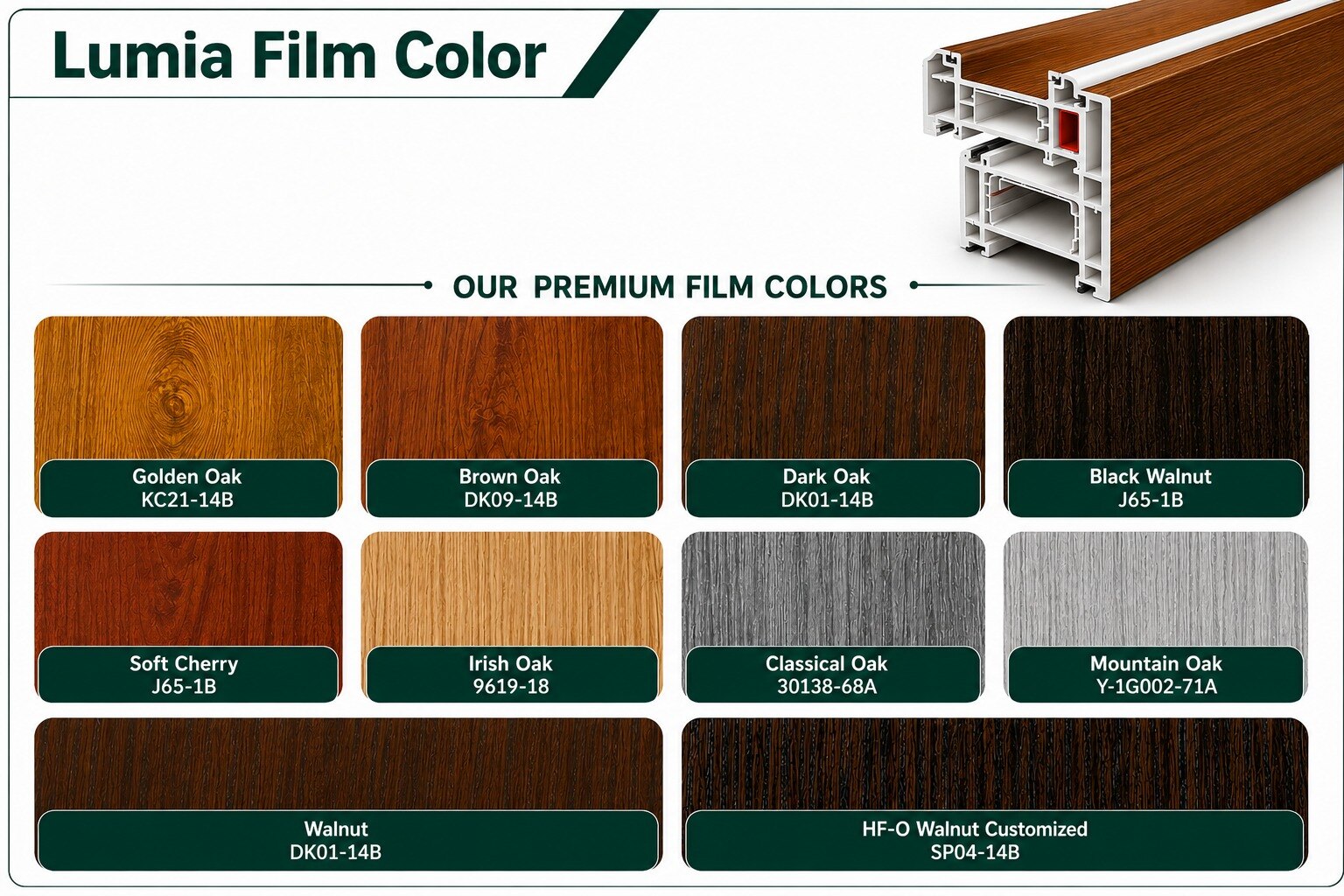
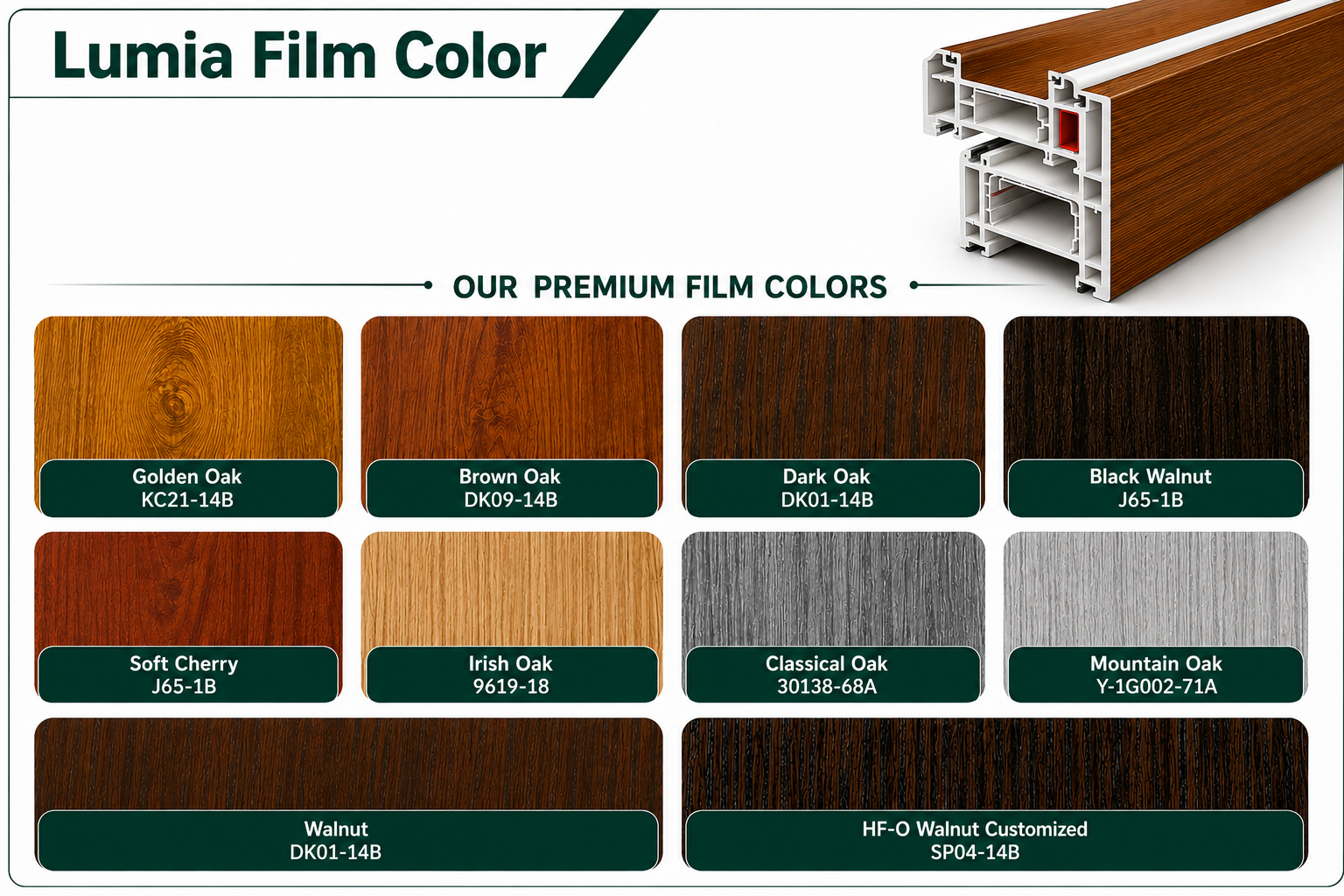 | Lumia Colors The Lumia Film Color Collection is designed to bring the natural beauty of wood and premium decorative finishes to modern uPVC window and door... View product → |
How to protect, clean and repair the finish
Deep scratches, abrasive pads and hot cutting debris are the fastest ways to make a laminated uPVC frame look permanently damaged. Treat the film as a finished surface, not as paint that can be sanded and recoated.
1. Store profiles separately from white stock, with film faces protected by clean separators. Do not drag lengths across concrete, metal racks or dusty benches; grit pressed into the surface leaves scuffs that polishing will not remove.
2. During machining and assembly, use clean supports and remove protective tape without knives. Set welding temperatures and pressure for the specific film system, then inspect every corner for lifting, blistering, melting or discoloured residue. A setting that works on white uPVC can damage a colored film.
3. Before installation, confirm that cut ends, drainage slots, end dams and sill falls match the approved system detail. Keep weep paths open and use only compatible sealants; blocked drainage or incompatible sealant can trap water behind the finish.
4. Clean with water, a soft cloth and a mild, non-abrasive detergent. Rinse dust before wiping, especially after Bengaluru’s dry periods, and avoid scouring powder, solvents, razor blades, pressure-washer jets and rough sponges.
5. Record the film code and keep replacement stock from the same batch or approved match. For damage, do not paint over a scratch or heat-weld a visible repair; follow the supplier’s repair method and replace the affected profile when the film has lifted, blistered or exposed the substrate.
Frequently asked questions
What does a colored film change on a uPVC window profile?
It changes the frame’s visible color and texture while leaving the uPVC profile’s core material unchanged. It is a factory-applied decorative layer, not site-applied paint.
How can you judge the quality of a colored uPVC film?
Check full film coverage, even color, consistent texture, clean corners, welds without exposed white lines, and samples viewed in daylight.
What should Bengaluru fabricators consider before approving colored profiles?
Review the film specification, sample approval, coverage at corners and welds, exposure to heat, rain and humidity, plus cleaning and repair procedures.
How should you clean and protect colored uPVC window profiles?
Use water and mild detergent with a soft cloth. Avoid abrasive pads, solvents, strong chemicals and sharp tools that can damage the film.