
A nominal 60 mm or 70 mm width does not prove that an auxiliary profile will fit a window system. You will be able to identify the correct profile type, verify compatibility with the base series, compare technical and installation details, and prepare a purchase specification for Chennai projects.
Key takeaways
- Identify the junction or finish before comparing auxiliary profile width.
- Match each auxiliary profile to the main system’s geometry and reinforcement.
- Check couplers, sills, bays and screen adapters before ordering.
- Request drawings, dimensions, seal details and compatibility confirmation in writing.
What an Auxiliary Profile Does in a uPVC Window Assembly
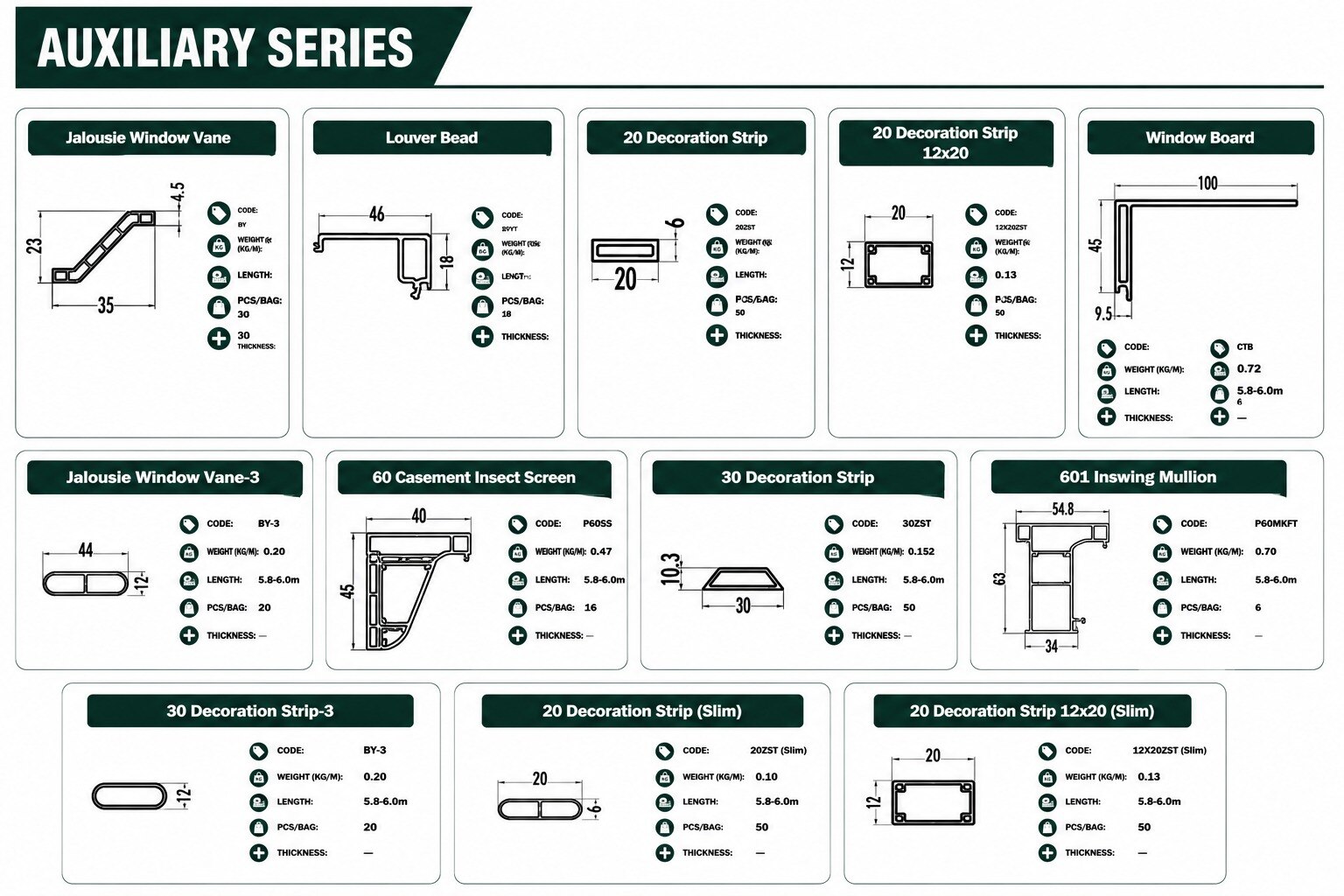
An auxiliary profile supports a specific junction or finish; it is not the main frame, sash, mullion, transom, glazing bead or steel reinforcement channel. When comparing auxiliary upvc profiles in Chennai, identify the job each profile performs before comparing width or appearance.
- Coupling profiles and expansion joints join adjacent frames or allow controlled movement.
- Angle and bay connectors turn or transfer loads at corners.
- Sill extensions, end caps and cover profiles manage projections, exposed edges and finish.
- Fly-screen adapters connect mosquito-screen frames to the window.
- Arch and specialty pieces solve curved or non-standard openings.
| Profile type | Assembly job | Main risk if mismatched |
|---|---|---|
| Coupler | Joins two frames | Joint opening, bowing or water entry |
| Frame extender or sill extension | Increases reveal or sill projection | Poor drainage or unsupported projection |
| Bay or angle connector | Forms a corner or bay | Load transfer failure |
| Fly-screen adapter | Provides screen engagement | Loose screen or damaged seal |
| Cover profile or end cap | Conceals and finishes an edge | Cosmetic gap or exposed joint |
A coupler aligns and seals frames, but it does not automatically replace a reinforced mullion, steel post or engineered support. Use wind-load calculations and the tested assembly to decide that requirement, especially for wide, stacked or corner windows.
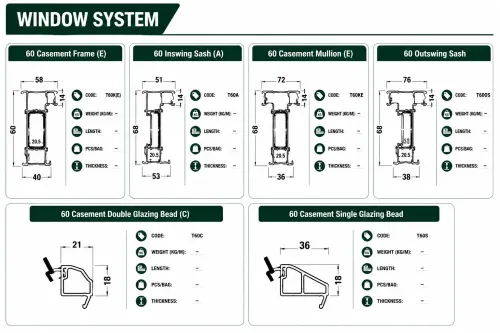
Check the mating system code, visible width, insertion depth, groove shape, gasket channel, reinforcement clearance and connector engagement. Nominally identical 60 mm or 70 mm profiles are not automatically interchangeable.
Match the Auxiliary Profile to the Correct Main System
Confirm fit by matching the auxiliary profile’s series code and mating geometry, not by its nominal width alone. A 60 mm auxiliary from one system is not automatically compatible with another 60 mm frame.
Use the main frame’s technical drawing and a dry-fit sample to verify:
- 60 Casement: confirm the casement frame code, insertion depth, gasket channel, glazing-bead relationship and reinforcement clearance.
- 60 Sliding: check the sliding frame or sash code, interlock position, connector engagement and whether the auxiliary preserves the sliding track and drainage route.
- 80 Sliding: verify the 80 Sliding chamber layout, coupling depth, seal location and clearance for the specified reinforcement.
- 99 Sliding: match the 99 Sliding mating profile code, groove shape, interlock alignment and frame-to-auxiliary cover dimensions.
- 110 Sliding: confirm the 110 Sliding frame drawing, deeper connection geometry, reinforcement space and compatible sill or cover parts.
Record the visible width, insertion depth, groove shape, gasket channel, reinforcement clearance and connector engagement for every proposed profile. Ask for the cross-section drawing, compatibility matrix, seal detail and joint instructions; a metre rate is not proof of compatibility.
Search results for upvc window auxiliary profiles in chennai are only a starting point. Test the actual coupler, sill extension or adapter on the intended frame. A coupler that aligns two frames is not a structural mullion: use the engineered reinforcement and wind-load design where the opening requires it.
Compare Dimensions, Reinforcement, Seals and Chennai Suitability
A system-matched auxiliary profile fits the mating frame’s geometry, not merely its stated width. To compare uPVC auxiliary series, check the visible width, insertion depth, chamber layout, wall thickness, groove shape and reinforcement clearance against the main system drawing.
| Check | System-matched profile | Visually similar universal profile |
|---|---|---|
| Dimensions | Correct connector engagement, gasket groove, bead line and glazing depth | Nominally similar width but loose joints, proud surfaces or incorrect glass position |
| Reinforcement | Provides the specified steel channel, screw engagement and tested assembly size | May leave unsupported uPVC, causing bowing, joint opening or screw pull-out |
| Seals | Matches the frame gasket, seal compression and drainage path | Forces seal stretching, silicone packing or an air-and-water leak |
| Finish | Matches colour, surface texture and cover-profile geometry | Creates a visible step or mismatched edge after installation |
Chennai’s heat, humidity and coastal air make reinforcement and fastening details decisive. Request the steel section, fixing spacing, minimum screw engagement and maximum tested size; do not accept “heavy duty” as evidence. A coupler can align and seal frames without providing the stiffness of a reinforced mullion, steel post or engineered corner.
Check the complete assembly for water and air performance. Treat fire rating separately: a standard auxiliary profile is unsuitable for a fire-rated opening, smoke-control door or protected escape route unless the entire frame, glass, hardware, seals and wall interface has been tested or assessed together.
Wider auxiliaries also do not prove better acoustics; glass, seals and installation control sound reduction.
Installation Checks for Couplers, Sills, Bays and Screen Adapters
A sill extension that covers a weep hole can cause leakage even when the main frame passed a water test. Check the auxiliary against the base system’s chamber layout, gasket groove, reinforcement clearance and connector engagement before cutting.
Use this site checklist for upvc auxiliary series for window fabricators in chennai:
- Cutting: follow the supplier’s cut-length and expansion-gap table; cut couplers, bay poles and sills square, and allow for thermal movement on long runs.
- Joining: use the specified corner blocks, end caps, welding method and joint sealant. Do not substitute a visually similar connector.
- Fixing: maintain the stated screw spacing and fixing points, keep reinforcement accessible, and avoid pinning a long sill or coupler so tightly that it cannot move.
- Sealing: apply only the compatible sealant in the specified sequence at coupler joints, sill ends, bay connections and screen-adapter interfaces. Sealant cannot correct a bowed frame or an oversized gap.
- Drainage: retain every frame weep hole, keep the sill extension’s drainage channel open, create the designed external fall, and prevent water from sitting between the main sill and extension.
- Screen adapters: confirm that the adapter does not obstruct sash movement, gasket seating or drainage paths after the fly screen is fitted.
For Chennai’s wind-driven monsoon rain, inspect the finished frame for square corners, continuous perimeter sealing and unobstructed weeps before glazing and handover. A cover profile hides a joint; it does not make that joint watertight.
Build a Purchase Specification Before You Buy in Chennai
A low metre rate is a poor basis for an auxiliary-profile order: unpriced connectors, wastage, reinforcement and future replacement can cost more than the profile. Record the specification against each opening before you buy auxiliary series in chennai.
1. Write the compatible base-series code, such as 60 Casement or 110 Sliding, finished width and height, chamber count, reinforcement cavity, gasket and bead code, supported glass range, tolerance and standard stock length.
2. Request joint details for couplers, sill extensions, bay poles, end caps and cover profiles. Include corner blocks, end closures, welding or joining method, compatible sealant, fixing points and drainage or weep-hole instructions.
3. Ask for the reinforcement section, screw-engagement depth, connector type and maximum tested or engineered assembly size. Do not accept “heavy duty” without evidence; unsupported uPVC can bow, open at joints or pull screws out.
4. Record colour, surface finish, minimum order quantity, lead time, replacement availability and batch-continuity terms. Approve a physical sample for white, laminated or dark finishes because a replacement from another batch can differ in shade or gloss.
5. Obtain installation drawings, dimensional tolerances and test evidence for the complete window configuration, including air permeability and water tightness. Do not treat a wider auxiliary profile as acoustic proof without glass, seal and installation test data.
LUMIA UPVC PROFILE should receive this completed schedule with the main-system code and opening details so its quotation can be checked against a specific assembly rather than a generic metre price.
Related product
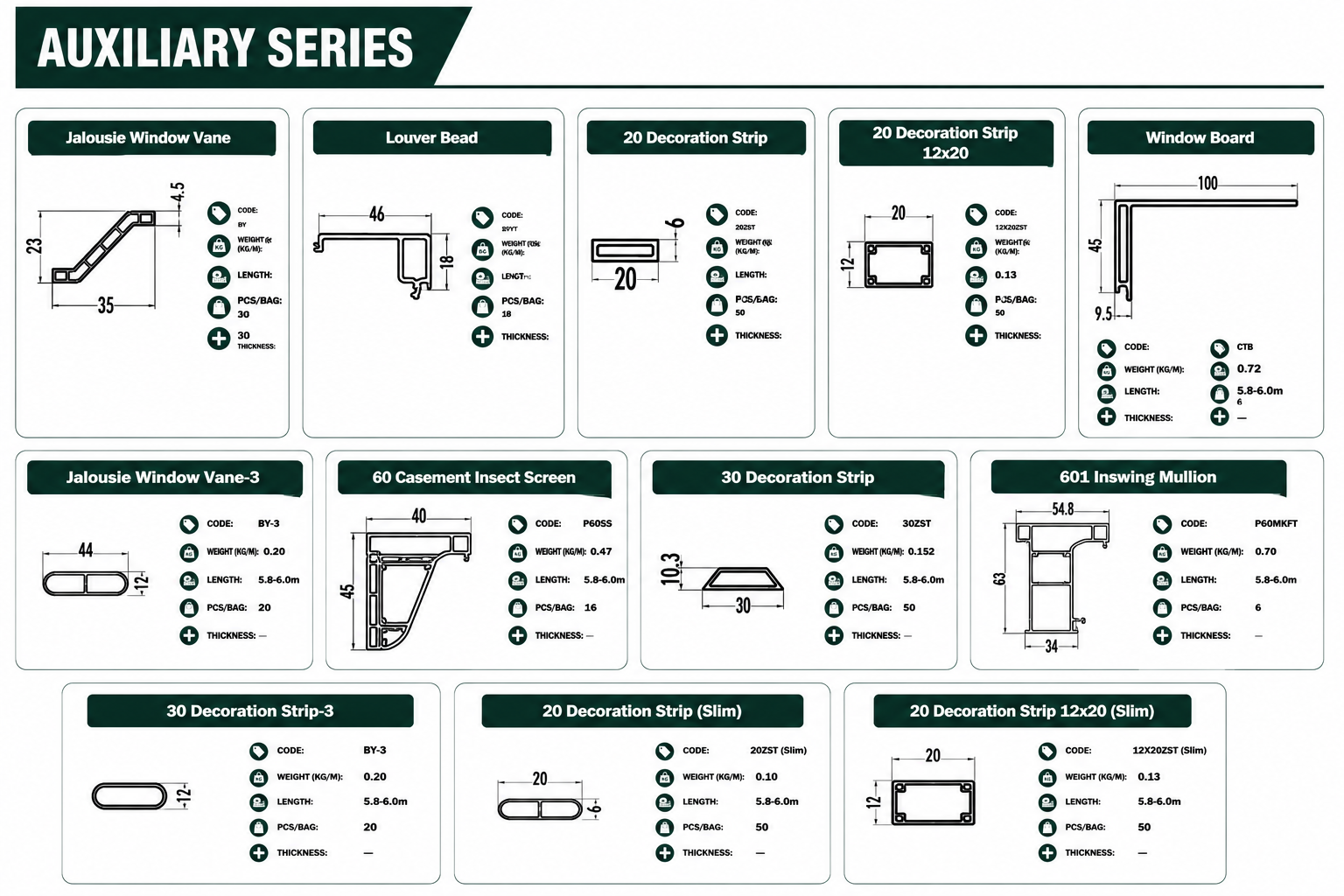 | Auxiliary Series The Auxiliary Series by Lumia uPVC Profile is designed to complement and enhance the performance, functionality, and aesthetics of uPVC window and... View product → |
Frequently asked questions
What does an auxiliary profile do in a uPVC window assembly?
It supports a specific junction or finish, such as a coupling, sill, bay connection or screen-adapter interface. It is not the main frame, sash, mullion, transom, glazing bead or steel reinforcement channel.
How do you match an auxiliary profile to the correct main uPVC system?
Confirm the main system series, profile geometry, connection method and reinforcement clearance. Compare the auxiliary profile drawing with the frame or sash section before placing an order.
Which details should Chennai fabricators compare between auxiliary uPVC profiles?
Compare finished dimensions, wall thickness, reinforcement space, seal location, drainage path, surface finish and compatibility with the project’s frame, sash, glass and hardware.
What should you check before buying auxiliary series in Chennai?
Prepare a purchase specification naming the application, main system, profile code, dimensions, colour, seal requirement, reinforcement arrangement, quantity and required technical drawings. Check couplers, sills, bays and screen adapters against the actual installation.