
Rain leakage rarely comes from the auxiliary section alone. The right choice depends on where water is entering, how the primary frame drains, and whether the opening is a casement, sliding door, bay, or coupled window. By the end, you will be able to match each monsoon problem to a profile type, verify compatibility before ordering, and request evidence for the complete installed assembly.
Key takeaways
- Match each auxiliary profile to the junction where water enters.
- Choose sills and thresholds that drain outward without trapping water.
- Confirm coupler and connector compatibility with the complete frame system.
- Request tested assembly evidence before selecting an auxiliary profile supplier.
Match the auxiliary profile to the monsoon failure point
A monsoon leak usually identifies the failed junction, not a shortage of sealant. Auxiliary uPVC profiles in Bengaluru include the parts that extend, join, drain, retain or finish a primary frame.
| Profile group | Monsoon failure point | Correct use |
|---|---|---|
| Sill extenders, sill adapters and drip-nose sections | Water lands in a deep reveal or runs onto the wall below the frame | Use a sill extension or drip nose to increase projection and create a defined outward discharge edge |
| Jamb extensions | Uneven masonry or a deep opening leaves the frame poorly aligned | Bridge the reveal and provide a sound perimeter sealing surface |
| Couplers, bay and corner connectors, and interlocks | Two frames meet and the junction leaks or shifts | Use a coupler or bay connector at the designed angle; match the interlock and anchorage instead of fitting an improvised strip |
| Reinforced mullion and transom connectors | Wide combinations move or deflect under wind | Transfer load into the anchors while allowing the planned movement of joined frames |
| End caps | An open profile end admits water or looks unfinished | Seal and finish the termination; an end cap is not a drainage solution |
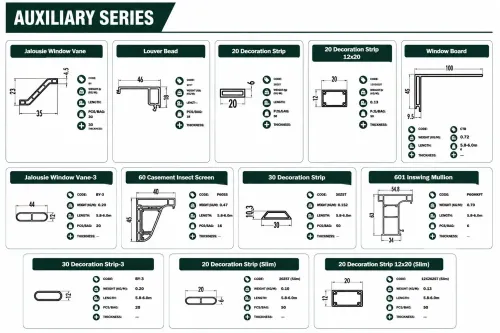
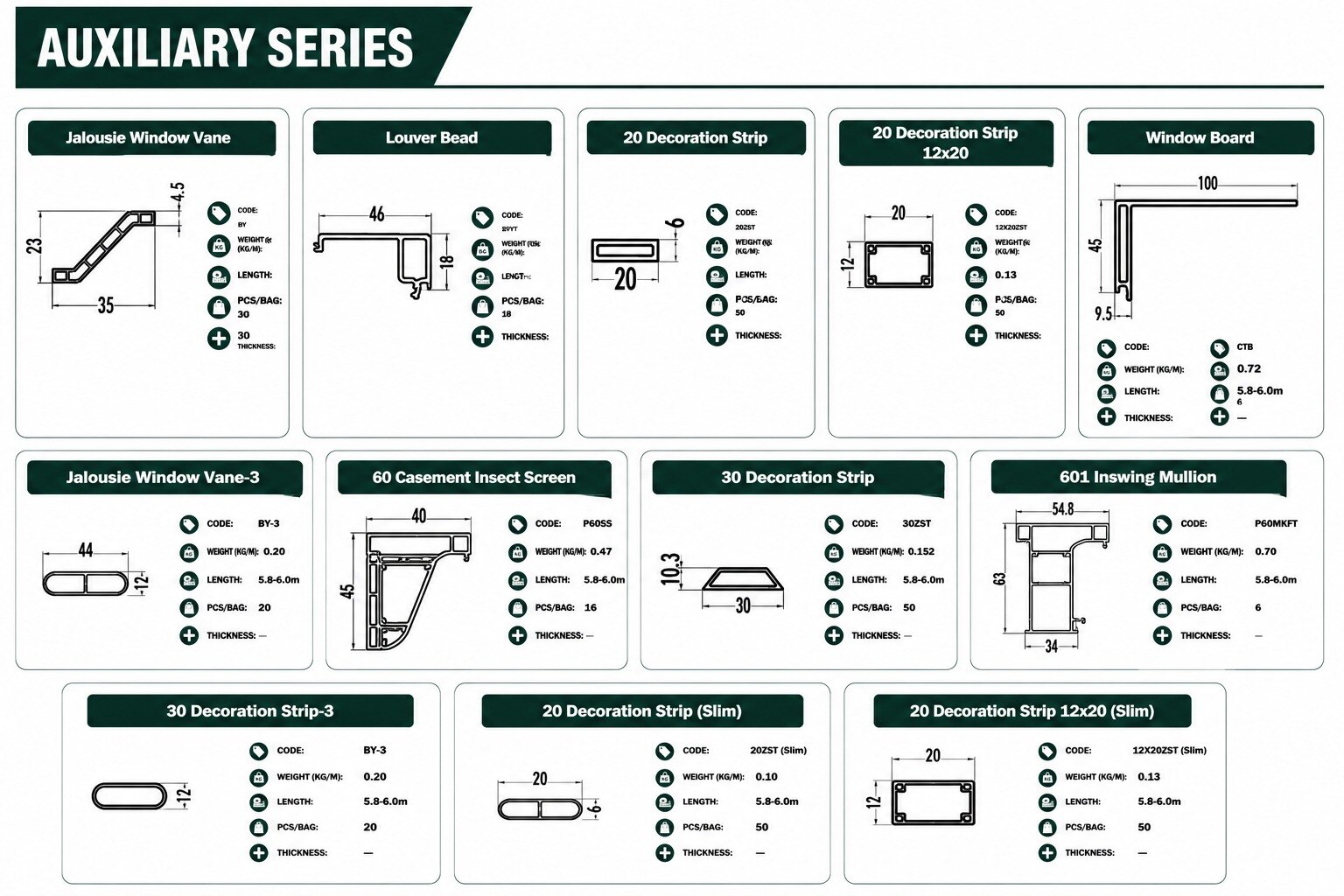
| Glazing beads and screen adapters | Glass, gaskets or flyscreens do not seat correctly, or a screen covers an outlet | Match the groove and keep drainage and sash engagement clear |
| Cover profiles | A visible joint needs protection or a cleaner appearance | Hide the joint only; a cover profile does not provide structural capacity or watertightness |
The best auxiliary uPVC profiles for monsoon in Bengaluru depend on façade exposure, building height, sill projection, opening type and wind-driven rain—not a generic “monsoon” label. Check drainage and perimeter joints before blaming a profile for condensation.
Choose sill, threshold and drainage profiles without trapping water
Choose a sill extender when the frame needs more projection, a positive outward fall or a defined discharge edge. Use sealant only at a correctly prepared movement joint; sealant cannot replace missing drainage in an upvc auxiliary series for monsoon.
| Option | Choose it when | Failure if misused |
|---|---|---|
| Sill extender or adapter | The reveal is deep, water lands below the frame, or the sill lacks outward projection | Water runs onto plaster instead of a defined drip edge |
| Sealant repair | A sound, clean movement joint has opened | Sealing over absent outlets traps water inside the sill |
| Drip nose | The discharge edge needs a clear break from the wall face | Rain tracks back beneath the sill without a proper fall |
Keep sill chambers, weep holes, track outlets and threshold channels continuous to the exterior. Do not let screws, mortar, foam, end caps or sealant block them. A low threshold is not automatically rain-resistant: inspect the threshold, interlock, track cover and drainage arrangement together on 60 Sliding, 80 Sliding, 99 Sliding and 110 Sliding systems.
Check these points before approving uPVC window auxiliary profiles:
- Confirm a flyscreen adapter does not cover outlets, obstruct rollers or prevent correct sash engagement.
- Clean dirt from track outlets before blaming the profile.
- Inspect the sill-to-wall joint, flashing and external fall as one drained interface.
Rain entry is different from condensation. Check indoor humidity, surface temperature, ventilation, cold glazing and perimeter joints before replacing a profile; high humidity or a cold bridge will not be cured by a cover section.
Use couplers and corner connectors for stable frame combinations
Two independently sealed frames are not a substitute for a designed joining profile. Use a compatible coupler when frames share a junction, especially where wind-driven rain can enter between them.
For a bay or angled opening, choose a corner or bay connector when the angle, anchorage and drainage must work through one planned junction rather than two unrelated frames.
A coupler must match the primary system’s interlocks, chamber geometry, reinforcement cavity, gasket grooves and fixing method. Wide windows and coupled runs need reinforced couplers, structural mullions or transoms that transfer wind load into the anchors while allowing planned movement.
Rigid PVC has a commonly used expansion value of about 0.07–0.08 mm/m·°C, so long runs require the manufacturer’s joint and fixing detail, not mortar packed into every gap.
Check these points before approving auxiliary uPVC profiles in Bengaluru:
- Request the system drawing and confirm the coupler’s interlock, gasket seating, reinforcement clearance and screw access.
- Use structural reinforcement specified for the tested assembly; an arbitrary steel flat can obstruct drainage, screws, welding or gasket seating.
- Confirm expansion joints, anchor spacing and movement allowances for the run’s length, colour, solar exposure and installation temperature.
- Keep chamber outlets and weep routes open at every junction; a connector that traps water creates a concealed reservoir.
- Treat a cover profile as a visual finish only. It hides a joint but provides neither structural capacity nor water-tightness.
Verify fit across 60 Casement and the Sliding Series before ordering
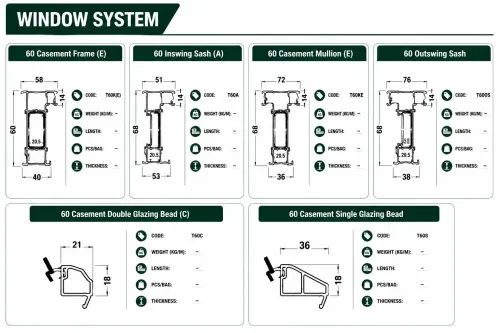
Before ordering, verify the auxiliary section against the exact 60 Casement, 60 Sliding, 80 Sliding, 99 Sliding or 110 Sliding system. A catalogue sample can look correct yet alter gasket compression, block drainage or leave no reinforcement clearance.
1. Request the system section drawing. Record profile width, frame and sash geometry, chamber locations, reinforcement space, glazing thickness, gasket groove, interlock shape, corner angle, required projection and joining method.
2. Measure the auxiliary profile’s actual height, width, wall thickness, insertion depth, snap engagement and fixing clearance. Compare each dimension with the drawing, not with a similar-looking uPVC window auxiliary profile.
3. Mark the frame drainage-hole locations and sizes, sill outlets, end-cap openings, sealant joints and any welding allowance. Confirm that screws, foam, mortar, end caps and sealant cannot interrupt the continuous route from internal chambers to the exterior.
4. Ask whether the part is designed for exposed exterior use, a sheltered junction, internal finishing or an aesthetic cover only. A cover profile does not provide drainage or structural capacity.
5. Require the stated installation tolerance, screw spacing, expansion allowance, corner detail and drainage route. Check the flyscreen adapter separately: it must not cover outlets or stop the sash reaching its designed engagement.
This checklist defines a usable uPVC auxiliary series for monsoon conditions. Reject any section that fits visually but changes gasket seating, obstructs a weep hole, prevents correct joining or reduces reinforcement clearance.
Specify the complete tested assembly and choose the supplier on evidence
Approve a monsoon-facing opening only after the supplier identifies the complete tested assembly, not just an auxiliary section. The best auxiliary uPVC profiles for monsoon in Bengaluru are proven with the primary frame, glazing, gaskets, couplers, threshold, drainage and installation detail together.
Request these documents before approval:
- Exact profile drawing with dimensions, chambers, interlocks and reinforcement cavity
- Material specification and reinforcement size, fixing and termination detail
- Compatible primary series, glazing thickness, gasket and coupler references
- End-cap, sill, threshold, track and drainage layout showing every outlet
- Installation instructions covering screw spacing, tolerances and movement joints
- Test report for the proposed assembly, including specimen dimensions and configuration
Use EN 1027 and EN 12208 for watertightness, EN 12207 for air permeability and EN 12210 for wind-load resistance. A result from a smaller plain window does not validate a changed sill, corner, coupler or threshold.
| Comparison | What to verify | Failure if changed |
|---|---|---|
| Watertightness | Same auxiliary series, glazing, gaskets and drainage | Water bypasses the tested path |
| Air permeability | Same joints, seals and dimensions | Leakage occurs at interfaces |
| Wind resistance | Same reinforcement, anchors and size | Deflection overstresses joints |
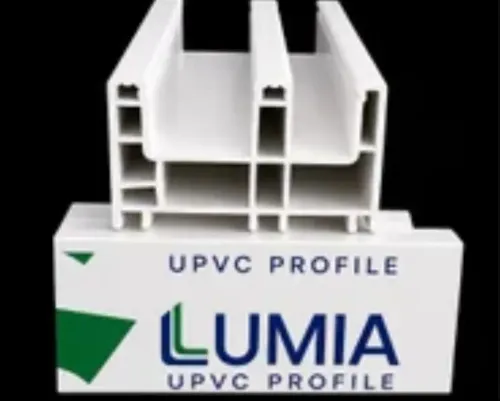
Require neutral-cure, uPVC-compatible sealant, joint backing, clean substrate preparation and movement allowance at masonry interfaces. Compare LUMIA UPVC PROFILE with any auxiliary profile supplier in Bengaluru only on these records and system details, never on a catalogue sample.
Related product
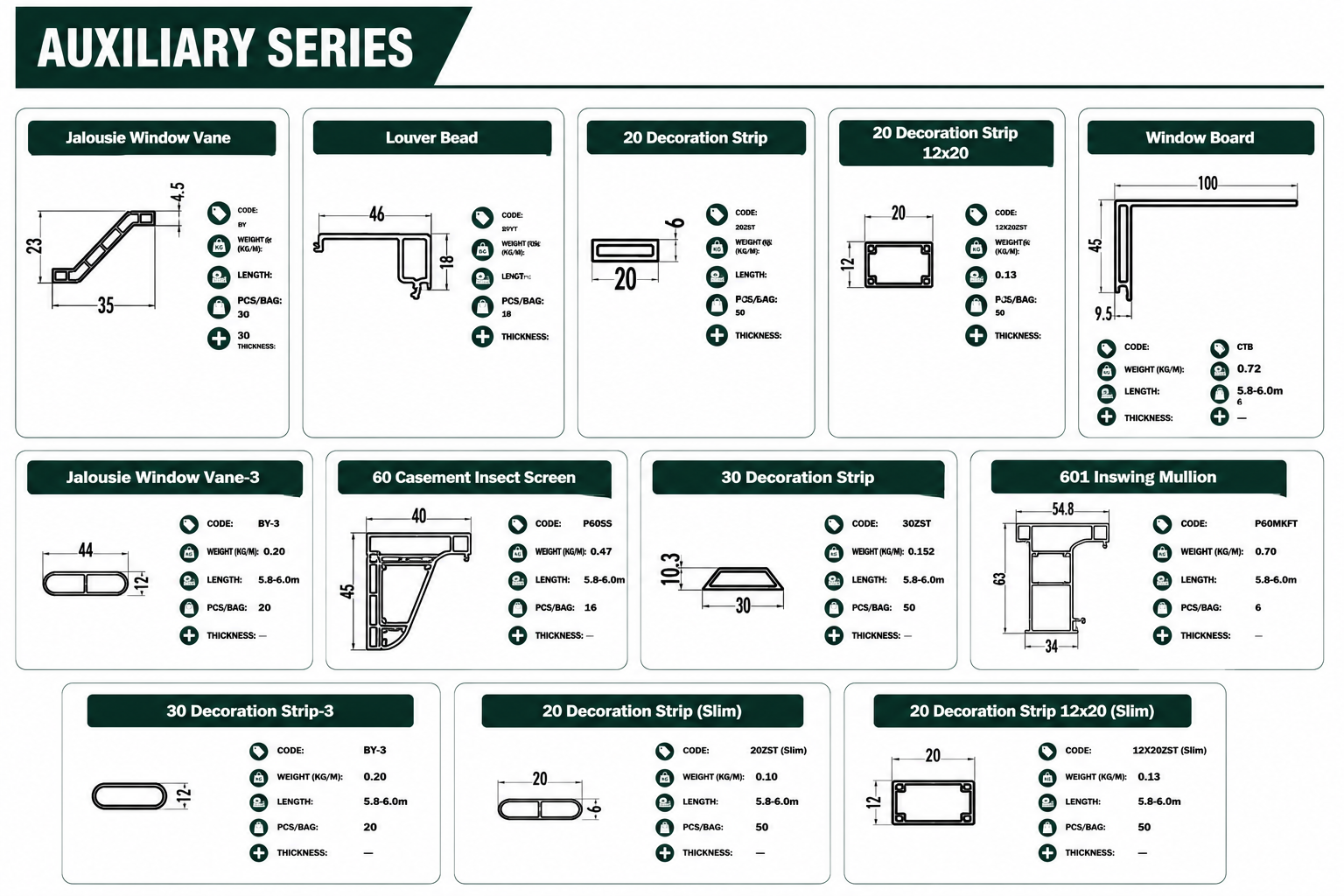 | Auxiliary Series The Auxiliary Series by Lumia uPVC Profile is designed to complement and enhance the performance, functionality, and aesthetics of uPVC window and... View product → |
Frequently asked questions
Which auxiliary uPVC profiles work best during Bengaluru monsoons?
Choose profiles that address the actual failure point, including drainage, sill, threshold, coupler and corner requirements.
How should you choose sill, threshold and drainage profiles?
Select designs that direct water outward and avoid closed pockets where water can collect behind the frame.
Why do couplers and corner connectors matter in monsoon installations?
They stabilise combined frame sections and help maintain consistent junctions where movement or gaps could cause leaks.
How can you verify fit before ordering auxiliary uPVC profiles?
Check compatibility across the 60 Casement and Sliding Series, then specify the complete tested assembly.